




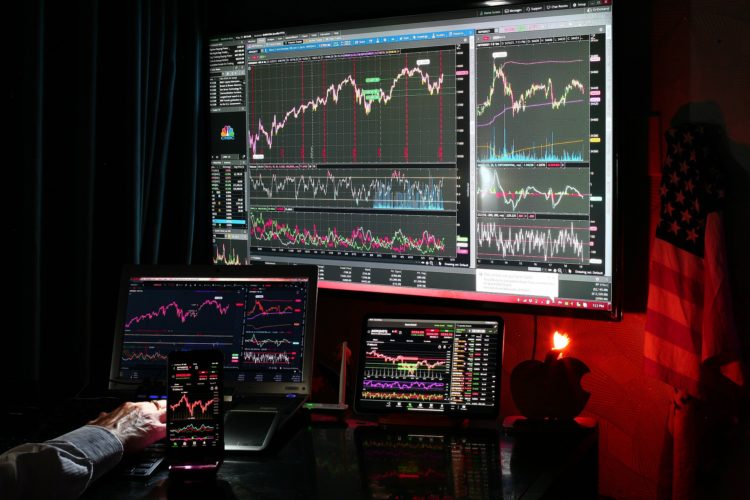
Thursday, November 5, 2026, was the day the AI trade broke. The Nasdaq Composite fell 5.52% to 24,315, entering correction territory about 11.9% below its October 6 record. The Philadelphia Semiconductor Index plunged 12.25%, its second-biggest fall on record. More than $2 trillion in Nasdaq market capitalization was wiped out in a single session, according to Reuters and Wall Street Journal reporting. The S&P 500 fell 4.36% to 7,354, its worst day since April 2025, and the Dow lost 1,833 points to 51,523.
The numbers describe a market that did not merely decline but changed its mind. For the past two years, the dominant investment thesis was simple: artificial intelligence would transform the economy, and the companies building the infrastructure for it would be rewarded without limit. On November 5, investors began asking whether the bill for that infrastructure would ever be paid.
What unwound
The epicenter was semiconductors. SanDisk fell 22.26%, Micron dropped 17.46%, and AMD slid 17.26%. Nvidia, the company whose chips power most AI training, fell 9.26%. The seven biggest technology companies together shed roughly $1.1 trillion in market value. The VIX, Wall Street's fear gauge, closed at 28.18, up 11.57 points — a spike that signals real anxiety, not routine profit-taking.
The trigger was a reassessment of the AI data-center buildout. Companies have committed staggering sums to building data centers, buying chips, and securing power. Investors had treated that spending as evidence of demand. On November 5, the same spending began to look like a liability: what if the data centers are built faster than the revenue to fill them? Democrats' sweeping midterm wins added political uncertainty to the mix, raising questions about the policy environment for big technology and AI infrastructure.
Not everything fell
The selloff was not indiscriminate, and the exceptions are instructive. Airbnb jumped 11% in after-hours trading after reporting third-quarter revenue up 19% to $4.87 billion. AppLovin surged 24% on its results. These are companies whose value comes from actual, current earnings and cash flow — not from a promise about infrastructure spending years from now.
The contrast captures the market's new mood. Investors are not abandoning technology; they are abandoning the assumption that spending equals value. A company that can show revenue growth today is being rewarded. A company whose story depends on capital expenditure tomorrow is being questioned.
What it means for startup fundraising
For founders raising money, the unwind changes the conversation in three ways.
First, valuations will face pressure. Private-market valuations tend to follow public-market multiples with a lag, and a 12% fall in the chip index and an 11.9% Nasdaq correction will eventually show up in the comparables investors use to price growth-stage rounds. Founders who raised at peak multiples in 2025 and early 2026 should expect harder questions and, in many cases, lower prices when they return to the market.
Second, the bar for AI startups rises. For two years, an AI pitch could rely on the momentum of the public market: if Nvidia was rising, an AI startup's prospects looked bright by association. That halo is gone, at least for now. Founders will need to show revenue, retention, and a credible path to profitability — the same fundamentals that carried Airbnb and AppLovin on a day when the market fell apart.
Third, timelines lengthen. When public markets are volatile, venture investors slow down. They take longer to decide, ask for more data, and hold larger reserves for existing portfolio companies. A founder who could have closed a round in six weeks in a calm market should plan for a longer process now, with more cash in the bank to survive it.
What it means for the data-center buildout
The buildout itself is unlikely to stop — too much capital has been committed, and too many projects are already under construction. But the terms may change. If investors demand evidence of returns, the companies building data centers will face pressure to slow new construction, sign customers before breaking ground, and demonstrate that each new facility generates revenue. That means a slower, more disciplined expansion than the market had priced in.
For startups that sell into the buildout — suppliers of chips, cooling, power management, and data-center software — the message is mixed. Demand is real, but customers will be more careful about spending, and sales cycles may lengthen. Startups with signed contracts and recurring revenue will fare better than those relying on a rising tide of infrastructure spending.
How founders should respond
The practical response is discipline, not panic: review runway, assume the next round takes longer and prices lower, cut spending that does not produce revenue or learning, and talk to existing investors early. Pitch the fundamentals — revenue growth, margins, retention — that the market rewarded on November 5 even as it punished everything else.
Investors, for their part, should remember that corrections create opportunity. The companies that survive a downturn with strong fundamentals intact often emerge stronger, with less competition and more disciplined operations. The AI trade may have unwound, but the underlying technology has not disappeared. The question is not whether AI matters, but which companies can turn it into a business — and that is a question best answered with evidence, not enthusiasm.
Angeled.com connects founders with investors.
Reuters, "Global markets: trading day"
Source: rockandturner.substack.com
Rock and Turner, "Thur, Nov 05, 2026 — The Market Today"
Read Next
The Data-Center Backlash Is Now an Election Issue — and Infrastructure Funding Will Feel It
Alphabet Discloses $548M Qualcomm Stake in Q3 13F Filing — What a 13F Really Shows
Friday's Bounce After the AI Rout: What the Rebound Really Signals
U.S. Stocks Plunge as Nasdaq Enters Correction in AI Trade Unwind
Ad-Tech Splits in Q3: Magnite's Connected TV Surges 39% While Criteo Shrinks 11%
Apple's Record Quarter Has a Catch: Memory Prices Are Eating the Margin